Original-article audit
What this source can support
Reviewed 15 August 2026 · geometry completeness 54/100 · medium-high
Three dossiers map to the article. The SEK 1,322.3m whole-airbase parent is a very-low-confidence screen using 9,000 m² / 96,875 ft² support-building proxy and 90,000 m² / 968,752 ft² pavement and is explicitly inclusive of the KC and BasC. Separate child component screens use 90 m²/SEK 30.7m for KC and 350 m²/SEK 55.6m for BasC, both pure Class 5 proxies. The source's generic 2,000–2,300 m by 30–40 m main-runway envelope shows that 90,000 m² / 968,752 ft² can be consumed by the main runway alone at the upper end; the parent does not visibly quantify two Eskilstuna short runways, aircraft roads, 20–40 dispersed positions or alert/service areas. Parent and child amounts must not be summed.
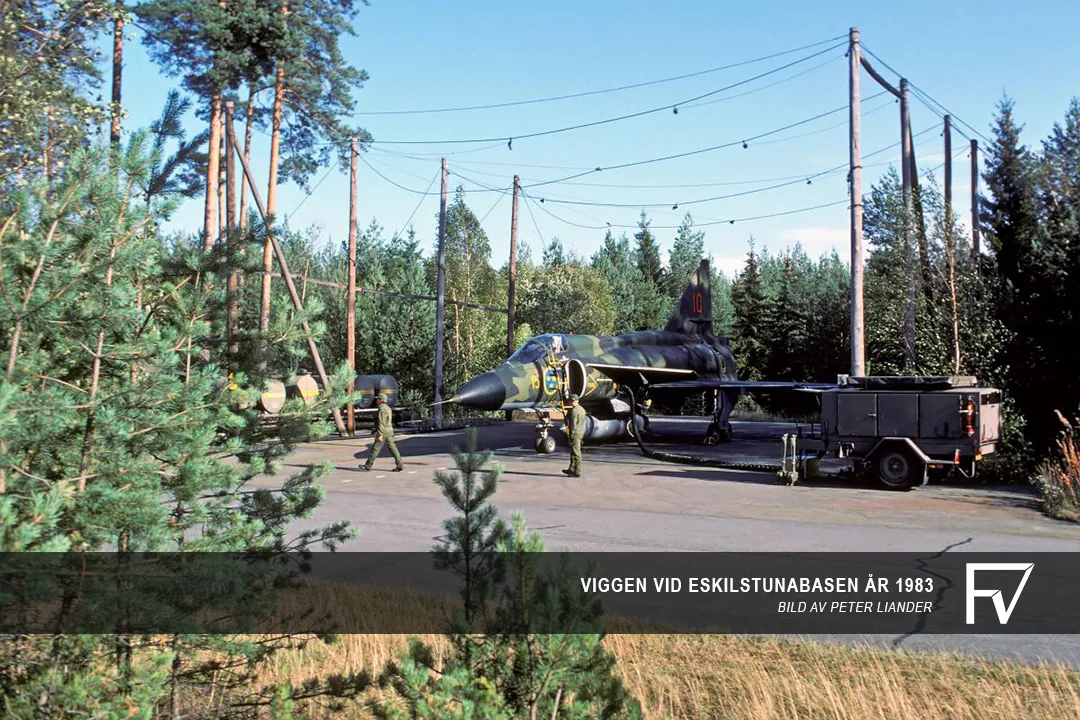
Supported useEskilstunabasen was a distributed Bas 60 attack base built 1960–1962 and converted toward Bas 90 from 1987, with a main runway, two built remote short runways, taxi/aircraft roads, alert and service areas, multiple dispersed fuel tanks, shelters, a buried concrete command centre (KC) and a later protected BasC completed in 1994. The article gives generic Bas 60 main-runway dimensions of 2,000–2,300 m by 30–40 m and generic Bas 90 short-runway length of 1,200 m, plus 10–15 rear alert positions and 20–40 Bas 90 aircraft positions. It does not publish Eskilstuna's surveyed pavement area or building areas.
Geometry evidenceinner_structure: Distributed surface airfield civil works combined with small earth-covered reinforced-concrete KC/BasC command bunkers, personnel shelters, aircraft weather/splinter shelters, dispersed fuel tanks and largely mobile/tented support. | other: value: 2,000–2,300 | unit: m | scope: generic Bas 60 main-runway length | note: Not explicitly measured at Eskilstuna.; value: 30–40 | unit: m | scope: generic Bas 60 main-runway width | note: Not explicitly measured at Eskilstuna.; value: 1200 | unit: m | scope: generic Bas 90 short runway including two about-200 m tapered ends | note: Eskilstuna had two built short runways (B and D); planned C was not built.; value: 10–15 | unit: rear alert/servicing positions | scope: generic Bas 60 bakom area | note: About 50 m between positions.; value: 20–40 | unit: aircraft positions | scope: generic Bas 90 base; value: 100 and 200 | unit: m³ per tank | scope: Eskilstuna dispersed buried fuel tanks | note: Number of tanks is not published.; A generic Bas 90 area covered two to four square Swedish miles and had two to four short runways; Eskilstuna specifically had two built short runways.; The Fällfors rock tunnel dimensions (150 m long, 20 m wide, 5 m high) describe another base and must not be assigned to Eskilstuna.
Systems describedsystem: command and communications | evidence: Earth-covered concrete KC for 6–8 people with telephone/radio; later EMP-protected BasC for overall command, weather and communications. Planned KC–BasC fibre was cancelled. | scope: KC archetype and Eskilstuna BasC/KC history; system: CBRN and resilience | evidence: BasC had own standby power and protection against biological and chemical weapons; later-built BasC variants had improved protection. | scope: BasC archetype, including Eskilstuna; system: airfield mission systems | evidence: Main-runway traffic-control and landing aids, base radio, telephone network, lighting, arresting systems, radar/peil and protected command functions. | scope: Bas 60/Bas 90 archetype; system: fuel and support | evidence: Multiple buried 100 and 200 m³ tanks at forward and remote locations; dispersed ammunition, workshops, field hangars, shelters and mobile support. | scope: Eskilstuna and archetype context; system: personnel and operating scale | evidence: About 1,500 personnel exercised the Eskilstuna part in 1994; about 2,000 at peak including personnel assigned to side bases. A KC held 6–8 people. | scope: site versus wider base group as labelled
Primary cost driversmain runway, two short runways and connecting aircraft-road pavement; 10–15/20–40 dispersed aircraft hardstands and alert/service areas; earthworks and utilities across a very large dispersed footprint; buried 100/200 m³ fuel tanks and distribution; protected KC, EMP/CBRN BasC and personnel shelters; landing, communications, lighting and base-control systems; weather/splinter shelters and field-maintenance infrastructure
Unit / programme scopeThe article mixes the Eskilstuna main base, the wider Eskilstuna group of side/reserve bases and generic Bas 60/Bas 90 design rules. Site-specific facts include two built short runways, KC/BasC history and dispersed fuel tanks; most dimensions are archetype ranges, not surveyed Eskilstuna quantities.
Revision directionRevised upward after source-specific review.
Missing inputssurveyed main- and short-runway dimensions and pavement build-ups; aircraft-road/taxiway lengths and widths; hardstand count, area and pavement section; KC, BasC and shelter areas, shell geometry and protection ratings; fuel-tank count, piping and containment scope; support-building inventory and areas; site boundary separating Eskilstuna from side/reserve bases; historic construction and Bas 90 conversion costs
Site / data issuesGeneric Bas 60/Bas 90 dimensions must not be represented as surveyed Eskilstuna values.; The 150 × 20 × 5 m rock tunnel belongs to Fällfors, not Eskilstuna.; The wider Eskilstuna base group includes several side/reserve bases; the dossier cost subject must define whether they are excluded.; The complete mapping adds KC and BasC child dossiers; they are incremental views already included in the whole-airbase parent and must not be added to it.; A reader correction says one exercise description omitted 'not'; comment-thread operational details should not drive the cost model.; The current 90,000 m² / 968,752 ft² pavement proxy likely omits major dispersed pavement scope documented qualitatively and by counts.