Original-article audit
What this source can support
Reviewed 15 August 2026 · geometry completeness 74/100 · High for area, main-tunnel length and major systems; low-to-medium for excavation volume, portal count and replacement mission scope.
The linked Nya berget published-scale model has a base concept of about SEK 2,182.8m. It correctly uses 22,000 m² / 236,806 ft² and two main approaches, but derives 110,000 m³ excavation from a 5x area factor and most concrete, reinforcement, fit-out, protection and mission-system quantities by proxy. The separately linked fuel hybrid model is about SEK 133m and uses a source-grounded 1,200 m³ tank capacity but an assumed 800 m² / 8,611 ft² envelope. The separately linked KC hybrid model is about SEK 50m and assumes 90 m² / 969 ft² from a six-to-eight-person generic Bas 60 crew statement that is not clearly specific to F 9's internal KC. The three model totals must not be added without removing overlap in hangar support, resilient utilities, fuel and command scope.
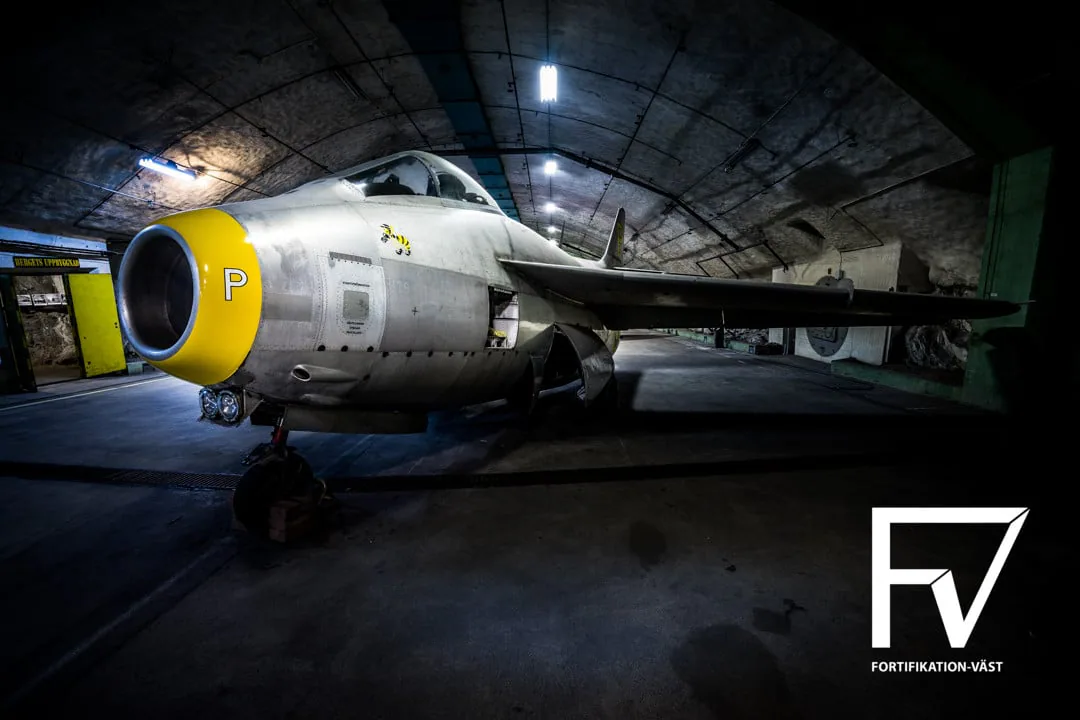
Supported useNamed F 9 Säve 'Nya berget' aircraft rock hangar completed in 1955, with 22,000 m² / 236,806 ft² floor area, a 407 m horseshoe main tunnel, approximately 20 m entrance width, about 30 m rock cover and capacity for at least 60 aircraft. It includes turntables, preparation positions, workshops, stores, power, fire protection and a command centre. The article also covers the separate old 8,000 m² / 86,111 ft² hangar, fuel facility, KC, Bas 60 and a national 38-airfield shelter proposal.
Geometry evidencearea_m2: value: 22000 m² / 236,806 ft² | scope: F 9 Nya berget | note: Reported hangar floor area.; value: 8000 m² / 86,111 ft² | scope: F 9 Gamla berget | note: Separate earlier hangar completed in 1943; must not be added to the focal Nya berget model unless whole-base scope is explicit. | tunnel_length_m: value: 407 | unit: m | scope: Nya berget main tunnel | note: Side-tunnel lengths and cross-sections are absent. | span_m: value: 20 | unit: m | scope: main entrance width | note: Reported as nearly 20 m. | portals: range: 2; 3 | unit: vehicle portals | scope: Nya berget | note: Two main horseshoe approaches are clear; the eastern portion was also split into airfield and road-network exits, so the total distinct portal count needs plan confirmation. | inner_structure: value: constructed hangar envelope separated from the rock by an accessible air gap | scope: Nya berget | note: Source_order 9 describes workers scaling rock in the air gap and repairing concrete damage, but does not state a freestanding structural system or anchor quantity. | other: range: 10; 12 | unit: m | scope: reported installation depth | note: The article separately reports nearly 30 m rock cover; reference datum is unclear.; value: 30 | unit: m | scope: rock cover above side tunnels | note: Reported as nearly 30 m.; value: 4 | unit: original turntables | scope: Nya berget | note: Two remained at article date.; value: 60 | unit: aircraft | scope: minimum reported capacity | note: Operational capacity, not a geometry take-off.; value: 90 | unit: t per shock door | scope: generic modern rock-hangar class discussion | note: Source_order 9 says approximately 90 t and installed at almost all hangars; it is not explicitly a measured F 9 door mass. The dossier's 80 t site-specific value comes from a separate archived F 9 source and must retain that provenance.; value: 1200 | unit: m³ fuel capacity | scope: separate linked F 9 fuel facility | note: Two reported tanks of 500 and 700 m³; this subfacility is beside/below Nya berget and must not be silently merged into hangar area.; value: 2.5 | unit: m | scope: separate linked F 9 fuel-facility barrier | note: Reported protected barrier thickness.
Historic-cost evidenceamount: SEK 305,000,000 | year: 1946 | basis: national proposal estimate | scope: Program for protected hangars at 38 airfields: 20 rock hangars and 18 concrete-hangar sites; not F 9 Nya berget construction cost.; amount: SEK 6,170,000,000 | year: 2017 | basis: publisher-stated equivalent | scope: 2017 equivalent of the 1946 national program proposal; not a unit or F 9 cost.
Systems describedOne-way aircraft flow through horseshoe tunnel, side-tunnel parking and turntables; Fuel, electrical, weapons and ammunition connections at preparation positions; Automatic sectional sprinklers and fire curtains; Supply/extract ventilation and dehumidified structural air gap; Two Nohab ship diesels capable of supplying hangar and airfield; Command centre, squadron spaces, accommodation, workshops, stores and fuel depot; Luminous escape markings, personnel counting and intrusion alarm
Primary cost driversLarge-cavern excavation and support; Main and side-tunnel cross-sections; Heavy shock doors and multi-portal layout; Aircraft preparation, workshop and fire systems; Ventilation/dehumidification and full-site standby power; Fuel/KC scope boundary and mission-system standard
Unit / programme scopeThe linked subject is one facility, Nya berget. The article also includes Gamla berget, the adjacent fuel facility, an internal KC, the wider Säve base, generic modern berghangar features and a national 38-airfield proposal. Those scopes are non-additive unless a whole-base/program model is explicitly requested.
Revision directionIndeterminate
Missing inputsMain and side-tunnel sections and lengths; Clear heights and total excavated volume; Portal plan and shock-door schedule; Concrete/reinforcement quantities; Rock-cover/depth survey with consistent datum; Fuel-facility and KC inclusion boundaries; Geotechnical/hydrogeological data; Public-safe protection and current-use brief; F 9-specific construction cost
Site / data issuessources_full.json links only the main Nya berget dossier, while source_dossier_map.json correctly adds the separate F 9 fuel-facility and KC dossiers supported by this article.; Gamla berget's 8,000 m² / 86,111 ft² is a separate facility and must not inflate Nya berget's 22,000 m² / 236,806 ft².; The 1946 SEK 305m figure is a 38-airfield program proposal, not a F 9 unit cost.; Reported 10–12 m installation depth and nearly 30 m rock cover use unclear reference datums and should not be treated as additive.; The dossier merges a separate archived F 9 source that reports an 80 t door and more explicit inner-structure detail; source_order 9 itself gives only a generic approximately 90 t hangar-door statement and an accessible air gap.; The source says no hangar was fully protected against nuclear blasts above one megaton; unqualified 'atom-bomb-safe' wording should not become a certified performance claim.; Separate fuel/KC dossiers can double count support systems already allowed in the main hangar model.; The F 9 KC model treats the article's generic six-to-eight-person Bas 60 KC staffing as focal F 9 KC evidence; that transfer should be labeled a class proxy, not published site quantity.