Original-article audit
What this source can support
Reviewed 15 August 2026 · geometry completeness 20/100 · low
status: linked model present | dossier_url: https://www.bunkerstrategy.xyz/intelligence/countries/Sweden/fortifications/se-fv-ftn | method: Archetype Derived / Archetype proxy | base_sek_2026_ex_vat: 96358500 | range_sek_2026_ex_vat: low: 37310000 | high: 241626667 | model_confidence: Very Low | basis: The model assumes a 350 m² / 3,767 ft² protected technical building plus one mission package covering radio, power and cooling. | assessment: The systems scope and one-node boundary are sound, and the work breakdown does not assume rock excavation. The 350 m² / 3,767 ft² scale, protection quantity and electronics package remain unsupported class proxies because the source provides only the 40 m mast and qualitative systems.
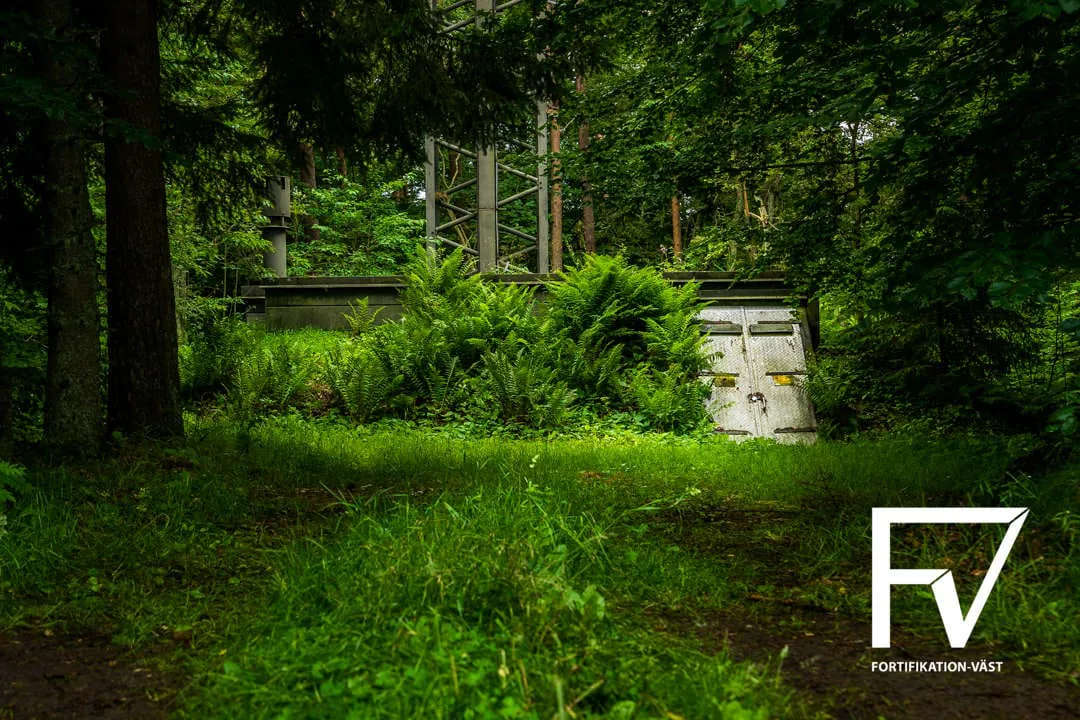
Supported useThe article combines national FTN history with one anonymous later-generation trunk-network link station. The focal station is a thick-walled green concrete bunker protected against EMP, with a 40 m antenna mast, ventilation/temperature control, dual diesel generator sets, batteries for no-break transition and large diesel tanks for endurance. Trunk nodes are terrain-adapted, protected against sabotage and bomb effects and may connect a high-importance subscriber by four diverse routes (two radio and two cable). No building area, wall thickness, foundation size, equipment count or cost is given.
Geometry evidenceheight_m: value: 40 | scope: antenna mast at the focal station | evidence: Explicitly reported. | inner_structure: Later-generation thick-walled concrete protected technical building; the article does not describe it as a rock cavern. | other: Antenna carriers have substantial foundations, but dimensions are absent.; A high-importance subscriber may have four diverse network paths, half radio and half cable; this is a network-design example, not necessarily the photographed node.
Systems describedEMP protection.; Bomb- and sabotage-resistant physical shell and intrusion alarm.; Ventilation and temperature control.; Dual diesel generator sets.; Battery reserve for uninterrupted power until generators are online.; Large diesel storage for prolonged operation.; Radio-link antennas/mast, cable routes, telephone/data transmission and remote network supervision.; Protected-site access controls.
Primary cost driversSecure concrete technical building and mast foundations.; 40 m antenna mast and radio-link equipment.; Dual generators, batteries, fuel and power conditioning.; Cooling/ventilation and EMP shielding/bonding.; Transmission, switching, monitoring and diverse cable/radio interfaces.; Physical security and intrusion detection.
Unit / programme scopeThe cost subject should be one anonymous trunk node. Network milestones, capacities and four-route examples describe FTN generally and must not be priced as though every item belongs to the photographed facility.
Revision directionHeld after source-specific review.
Missing inputsBuilding footprint, usable area and number of levels.; Wall/roof thickness and reinforcement.; Mast type, foundation size and antenna loading.; Generator ratings, fuel volume and battery autonomy.; Cooling load and protected-ventilation specification.; Transmission/switching inventory and current mission-equivalent capacity.; Site civils, cable routes and security perimeter quantities.
Site / data issuesThe article repeatedly switches between the national FTN and one focal station; national attributes should be tagged as archetype/program evidence.; The model's 350 m² / 3,767 ft² is an assumption and must not be reported as published area.; The focal building is described as concrete; do not substitute a rock-cavern archetype without new evidence.