Original-article audit
What this source can support
Reviewed 15 August 2026 · geometry completeness 34/100 · medium-low
The linked dossier's SEK 793.8m base estimate is an archetype proxy using 5,000 m² / 53,820 ft², 32,500 design m³ and four civil emplacement packages. The 5,000 m² / 53,820 ft² proxy is tied to the reported roughly 500-person establishment but is not a published area. Four emplacement packages capture only a subset of the article's turret/casemate and outer-defence inventory; the programme-wide 600,000-tonne figure cannot correct the unit excavation quantity.
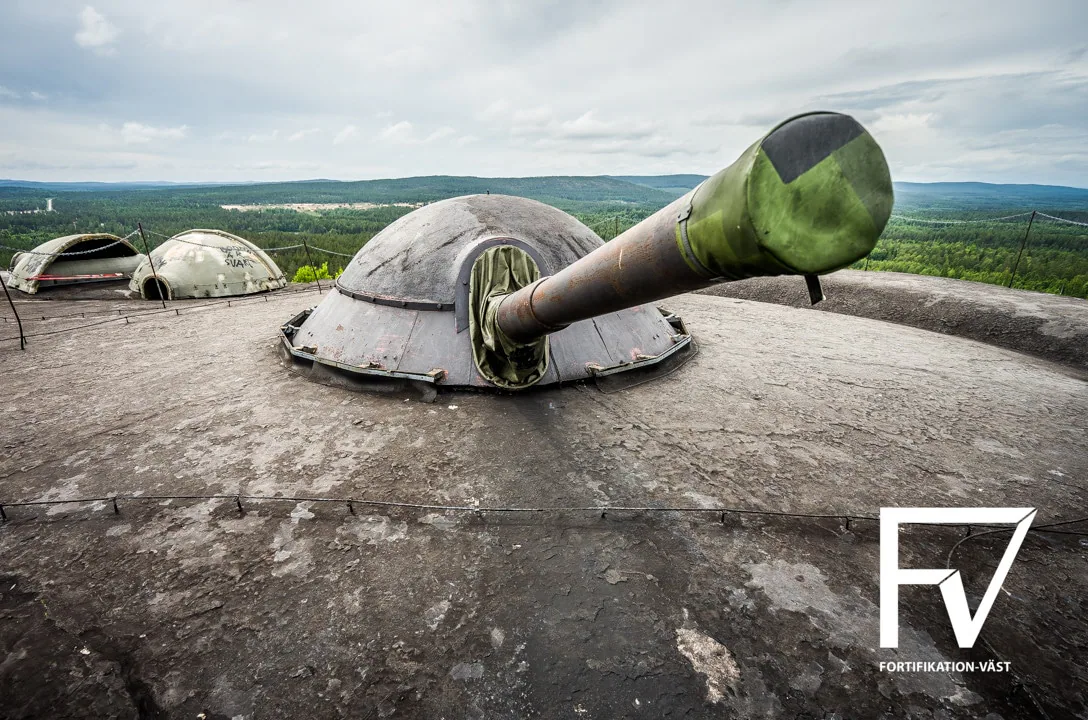
Supported useRödbergsfortet was excavated from 1903 and completed five years later as one of five autonomous rock forts in Boden fortress. The article gives a Rödbergsfort wartime establishment of 251 artillerymen, 229 infantrymen and 20 engineers (500 people) and identifies multiple turret, casemate and outer-defence positions. It gives no Rödbergsfort floor area or excavation volume. The approximately 600,000 tonnes of blasted stone, 16-year construction period and 1,200 objects refer to the whole Boden fortress programme, not this fort.
Geometry evidenceinner_structure: Autonomous rock artillery fort with galleries, ammunition magazines, machine rooms, command rooms, medical spaces, sleeping and dining rooms, concrete/masonry casemates and armoured gun turrets; no freestanding inner-building geometry is stated. | other: value: 600000 | unit: tonnes of blasted rock | scope: entire Boden fortress programme | note: Includes five rock forts, moats, tunnels, chambers and gun wells; cannot be allocated to Rödbergsfortet.; Rödbergsfortet's original armament is stated as four 15 cm turret howitzers, four 8 cm turret guns and eight 6 cm casemate guns. The later inventory is four 12 cm turret guns, four 8.4 cm turret guns and four 5.7 cm casemate guns.; Appurtenant works named for Rödbergsfortet include a deep and broad moat on three sides, a cliff on the fourth, a separate two-gun satellite battery, four infantry redoubts, two observation posts and north/south searchlight tracks.
Historic-cost evidenceamount_sek: 3.50 | price_date: Boden fortress construction era | basis: rock blaster wage per shift | scope: programme labour rate, not facility cost | note: The article gives a claimed 2017-equivalent of SEK 210 per shift; it publishes no Rödbergsfort construction cost.
Systems describedsystem: autonomy and habitability | evidence: The five forts were autonomous, with sleeping/dining rooms, machine rooms, ammunition magazines, stores, command rooms and medical departments. | scope: Boden rock-fort archetype; system: power and heating | evidence: Originally coal/wood stoves; the fortress was electrified and fitted with central heating during the 1910s. | scope: Boden fortress programme; system: water and sanitation | evidence: Water closets are specifically noted as important, but water-supply and sewage geometry/capacity are absent. | scope: Boden forts generally; system: communications | evidence: A large, nodal telephone network was installed across the fortress to survive bombing and artillery fire; a separate radio bunker is also described. | scope: entire Boden fortress, not solely Rödbergsfortet; system: mission equipment | evidence: Multiple turreted heavy and medium guns, casemate flank guns, observation posts and searchlight tracks; later heavy-gun replacement increased range. | scope: Rödbergsfortet and its named outer works
Primary cost driversfort-gallery and gun-well excavation; rock support and long-term rock-condition risk; armoured turret/cupola and casemate civil works; deep perimeter moat and terrain shaping; autonomous accommodation, stores and utilities for about 500 personnel; satellite battery, infantry redoubts, observation posts and searchlight infrastructure; heritage-grade masonry, steel and restoration requirements
Unit / programme scopeThe named subject is one fort, but substantial evidence is for the five-fort/1,200-object Boden fortress programme. Rödbergsfort-specific staffing totals 500 and its weapon/outer-work counts are unit evidence. The 600,000 tonnes is programme-wide.
Revision directionRevised upward after source-specific review.
Missing inputssurveyed fort footprint, gallery lengths, cross-sections and levels; Rödbergsfort-only excavation volume separated from moat spoil; turret-well, casemate and ammunition-space dimensions; moat length, width and depth; scope boundary for satellite battery and outer redoubts; site-specific concrete, masonry, armour and rock-support quantities; original Rödbergsfort construction and modernization costs
Site / data issuesDo not assign the 600,000 tonnes of rock or 1,200 objects to Rödbergsfortet; both are fortress-programme figures.; The article alternates original and later armament; replacement scope needs a chosen date/function.; The dossier's four mission packages appear narrower than the article's full emplacement and outer-defence scope.; Reported personnel for the other four forts are contextual and must not be added to the Rödbergsfort unit model.